Working in Europe From Moldova: Work Permits, Best Countries and Rules (2026)
Can Moldovans work in Europe? Yes, with a job offer. Moldovan citizens are named in more special work routes than almost any other nationality we check: Poland's declaration, Hungary's National Card, Romania's D/AM1 visa, two Czech routes and Italy's quota list. Here is how they compare, with sources.
Countries we check for you
- 1
 Answer aboveGermanyEU Blue Card, Skilled worker with recognised qualification, Opportunity Card (Chancenkarte)
- 2
 Answer aboveUnited KingdomSkilled Worker visa, Health and Care Worker visa
- 3
 Answer aboveNetherlandsHighly skilled migrant, EU Blue Card
- 4
 Answer aboveSwedenWork permit, EU Blue Card
- 5
 Answer aboveDenmarkPay Limit Scheme, Positive Lists
- 6
 Answer aboveNorwaySkilled worker residence permit
- 7
 Answer aboveSwitzerlandPermit for non-EU/EFTA workers (quota)
- 8
 Answer aboveAustriaRed-White-Red Card, EU Blue Card
- 9
 Answer aboveSpainWork and residence authorisation
- 10
 Answer aboveItalyWork permit within the annual quota (Decreto Flussi), EU Blue Card
- 11
 Answer aboveIreland
- 12
 Answer aboveFrance
- 13
 Answer aboveBelgium
- 14
 Answer abovePoland
- 15
 Answer aboveMalta
- 16
 Answer aboveLuxembourg
- 17
 Answer aboveCroatia
- 18
 Answer aboveCzechia
- 19
 Answer aboveEstonia
- 20
 Answer aboveRomania
- 21
 Answer aboveGreece
- 22
 Answer aboveHungary
- 23
 Answer aboveLithuania
- 24
 Answer aboveIceland
- 25
 Answer abovePortugal
- 26
 Answer aboveSlovakia
- 27
 Answer aboveSlovenia
- 28
 Answer aboveBulgaria
- 29
 Answer aboveLatvia
- 30
 Answer aboveFinland
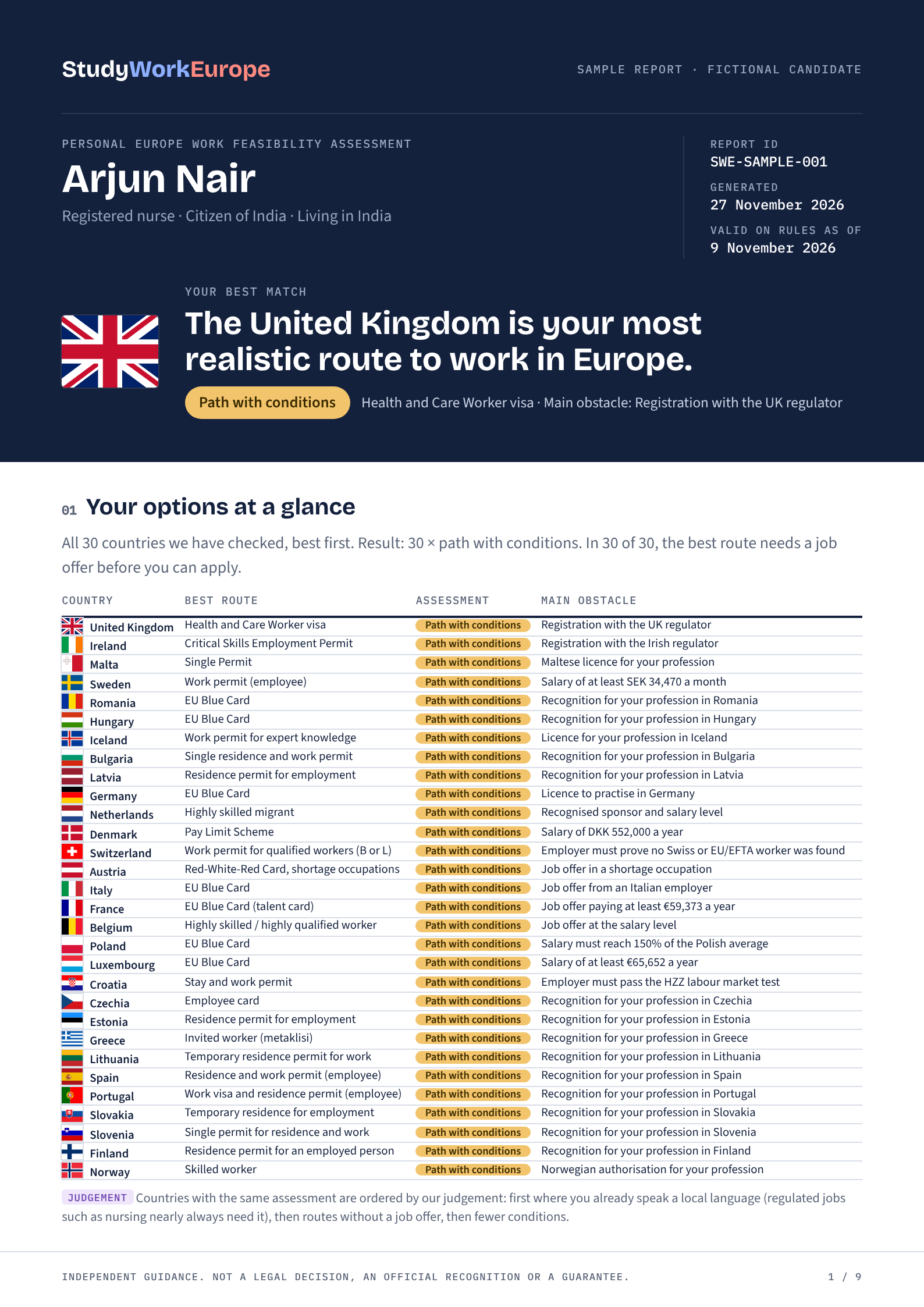
Choose your field and education above. We then check you against the rules of these 30 countries, whose rules we have checked against official sources. More countries follow when their rules are checked.
What people from Moldova need to know
Can Moldovans work in Europe? Yes, with a job offer. Moldovan citizens are named in more special work routes than almost any other nationality we check: Poland's declaration, Hungary's National Card, Romania's D/AM1 visa, two Czech routes and Italy's quota list. Here is how they compare, with sources.
Short answer: yes. A Moldovan passport is named in five special work routes in four EU countries: Poland, Hungary, Romania and Czechia (two routes). Italy also lists Moldova for its reserved quota places. Every one of these routes still starts with a real employer. None of them can be bought.
If you also hold the passport of an EU country, you are an EU citizen and can work in the EU without a permit. This page is for people who travel on a Moldovan passport only.
Five routes that name Moldova
| Country | Route | Who else can use it | What makes it easier | Guide |
|---|---|---|---|---|
| Poland | Declaration on entrusting work | Armenia, Belarus, Ukraine | No full work permit. Employer pays PLN 400. | Work in Poland |
| Hungary | National Card | 7 other nearby countries | No labour office check. Any job, also through an agency. | Work in Hungary |
| Romania | Visa D/AM1 | Ukraine, Serbia | Employer applies alone, without a placement agency | Work in Romania |
| Czechia | Qualified Employee Programme | 11 other countries | A set chance to apply at the embassy. Quota 1,500 for Moldova in 2025. | Work in Czechia |
| Czechia | Special work visa (farming, forestry, food) | Bosnia and Herzegovina, Georgia, North Macedonia, Ukraine | Apply in Chisinau. Only until 31 December 2026. | Work in Czechia |
Which one fits you is our judgement: if you have a job offer in one of these countries, ask the employer which route they will use. The quick check above compares all the countries we check for your job and education.
How the routes compare
| Poland: declaration | Hungary: National Card | Romania: D/AM1 | Czechia: programme | Czechia: special visa | |
|---|---|---|---|---|---|
| Who applies | Employer, online | You or the employer | Employer, on WorkinRomania | You, at the embassy | You, in person |
| Length | Up to 24 months of work | Up to 2 years, renewable for up to 3 years at a time | Length of the contract, up to 2 years | Employee card for up to 2 years, renewable | Up to 1 year, no extension |
| Main cost | PLN 400 (employer pays) | €110 at an embassy | Visa D €300, then RON 265 + €120 for the permit | CZK 5,000 at an embassy | Not shown on the Czech page we checked |
| Which jobs | Not seasonal jobs | Any job | Full-time jobs | Mid- and lower-skilled jobs | Farming, forestry, food only |
Poland: declaration instead of a work permit
Since Poland’s new law of 1 June 2025, only citizens of Armenia, Belarus, Moldova and Ukraine can work on a declaration (oświadczenie). The employer registers it at the local labour office and pays PLN 400. With the registered declaration you apply for a national (D) work visa. It cannot be used for seasonal jobs.
Hungary: National Card
Hungary’s National Card is only for citizens of Bosnia and Herzegovina, North Macedonia, Belarus, Moldova, Montenegro, Russia, Serbia and Ukraine. It works for any job, including through a staffing agency. The labour office does not check whether a Hungarian could do the job. OIF says you can apply in Hungary if you have a biometric passport.
Romania: D/AM1 without an agency
Since Romania’s new law of 27 April 2026, most foreign workers need a licensed placement agency and a job on Romania’s shortage occupation list. Citizens of Moldova, Ukraine and Serbia working full time use the D/AM1 route instead: the employer applies directly on WorkinRomania.
Our reading of the law: the shortage list and the yearly quota are written for the other route (D/AM2), not for D/AM1. IGI does not say this directly. Ask IGI or your employer before you rely on it.
For long-term residence in Romania, you now need a certificate showing Romanian at level A2 or higher (from 27 April 2026). If you already speak Romanian, you still need the certificate.
Czechia: two routes
- Qualified Employee Programme: for jobs such as welders, drivers and assembly workers. Your employer must be accepted into the programme. You still need an employee card. Moldova’s quota in 2025 was 1,500 applications (Czech Ministry of the Interior). Quotas may have changed in 2026.
- Special work visa: only for citizens of Bosnia and Herzegovina, Georgia, Moldova, North Macedonia and Ukraine, for farming, forestry and food production. Both you and the employer must be in the Ministry of Agriculture’s programme, and the employer may not be a job agency. Moldovans apply in person in Chisinau. Applications close on 31 December 2026. Time on this visa does not count towards permanent residence.
Italy: Moldova is on the quota list
Italy’s quota decree for 2026 to 2028 gives 25,000 reserved non-seasonal places a year to citizens of 38 listed countries. Moldova is on the list. Moldovan citizens can also use the seasonal quota for farming and tourism. For 2027 there are 89,000 seasonal and 76,200 non-seasonal places. An Italian employer must apply for you on a fixed “click day”. Work in Italy
Slovakia: national visa for bus and truck drivers
Moldova is one of 19 countries whose citizens can get Slovakia’s national visa for international bus and truck drivers. It is only for these two jobs.
- At most 5,000 of these visas can be given in 2026.
- The employer must have been a Slovak transport company for at least 10 years.
- The visa lasts up to 1 year and cannot be given again. While you hold it, you may only work for that employer, in that job.
- If you later apply for temporary residence for the same job, the labour office does not first look for a local jobseeker.
You still need a real job offer from the transport company. Work in Slovakia
Bulgaria: a labour migration agreement
Bulgaria and Moldova have an agreement on labour migration, in force since 11 September 2018. Under it, Bulgaria’s Employment Agency and Moldova’s National Employment Agency help select workers.
- Workers hired under the agreement do not count towards Bulgaria’s limit on foreign staff (normally at most 20% of an employer’s staff, 35% for small and medium-sized firms).
- You still need a job offer and Bulgaria’s single residence and work permit.
- Ask Moldova’s National Employment Agency about current vacancies. Work in Bulgaria
Greece: agreement planned, not confirmed
In February 2024 Greece’s migration ministry said it planned work agreements with Armenia, Georgia, Moldova, Vietnam, India and the Philippines. We could not confirm that an agreement with Moldova is in force. Do not trust anyone who sells a place under a “Greece–Moldova agreement”. Work in Greece
Norway and the UK
- Norway: when we checked UDI’s seasonal worker page for Moldovan citizens, its warning about the home country was not shown. You still need a full-time seasonal job offer. Work in Norway
- UK TB test: Moldova is on the UK TB test list. If you have lived in Moldova for 6 months or more, and were living there in the last 6 months, you need a chest x-ray at a Home Office approved clinic before a UK visa of 6 months or more.
- UK English: Moldova is not exempt from the English test. UK work visas need level B2.
- UK Youth Mobility: not open to Moldovan citizens. A “UK working holiday visa” offer is a warning sign.
- UK health jobs: Moldova is not on the UK red or amber list. UK red list explained
Language
Each route is in a country with its own language: Polish, Hungarian, Romanian, Czech or Italian. The permits above do not test the language, except for Romanian A2 for long-term residence. Employers often still expect it. Language levels explained
Avoid scams
- Five routes name Moldova, so agents use them in their adverts. All five start with an employer. The declaration, the National Card, D/AM1 and the Czech routes cannot be bought from an agent.
- In Romania, agencies and employers may not charge you any fee for finding the job.
- The Czech special visa ends on 31 December 2026. An offer for it in 2027 needs checking on the Czech portal.
- Check if an employer can sponsor you, read job scams in Europe and never pay for a job.
What this means for you
- No degree? You have more choice than most non-EU citizens: Poland, Hungary, Romania, Czechia and Italy’s quota. Start with the country where you have a real job offer.
- Farm work? Italy’s seasonal quota and the Czech special visa (until the end of 2026) are open to you, and Hungary’s National Card works for any job. Poland’s declaration is not for seasonal jobs. More: seasonal and low-skilled jobs in Europe.
- Degree and a skilled job? Germany, the Netherlands and the EU Blue Card are open on the same terms as for other non-EU citizens. Check the pay with the work permit salary check.
- Compare all 32 countries in jobs in Europe for foreigners.
Sources
- Biznes.gov.pl (Polish government service portal), Declaration on entrusting work to a foreigner (in Polish) Updated 1 December 2025. Checked 11 November 2026
- National Directorate-General for Aliens Policing (OIF, Hungary), National Card (Nemzeti Kártya, in Hungarian) Page last edited 3 March 2026. Checked 13 November 2026
- IGI (General Inspectorate for Immigration, Romania), Long-stay visa for employment (in Romanian) Page updated 8 June 2026. Checked 13 November 2026
- IGI, Emergency Ordinance 32/2026 on foreigners' access to the labour market (PDF, in Romanian) Published in the Official Gazette no. 335 of 27 April 2026. Checked 13 November 2026
- Information Portal for Foreigners (Czech Ministry of the Interior), Programmes approved by the Government Updated 7 July 2025. Checked 12 November 2026
- Information Portal for Foreigners (Czech Ministry of the Interior), Special Work Visa Updated 28 July 2026. Checked 12 November 2026
- Czech Ministry of the Interior, Report on migration and integration of foreigners 2025 (in Czech) Published 10 July 2026. Checked 12 November 2026
- Integrazione Migranti (Italian Ministry of Labour), DPCM of 2 October 2025 on entry flows 2026–2028 (PDF, Articles 6 and 7) Published in the Gazzetta Ufficiale on 15 October 2025. Checked 15 November 2026
- Ministry of Migration and Asylum (Greece), '2024 is the year of legal migration' (planned bilateral agreements, in Greek) 7 February 2024. Checked 13 November 2026
- UDI (Norway), Want to apply – Seasonal workers (citizenship Moldova) Checked 17 November 2026
- GOV.UK, Tuberculosis tests for visa applicants Updated 27 October 2026. Checked 17 November 2026
- GOV.UK, Skilled Worker visa – knowledge of English Updated 14 September 2026. Checked 17 November 2026
- GOV.UK, Youth Mobility Scheme visa – eligibility Updated 16 September 2026. Checked 17 November 2026
- GOV.UK, Code of practice for the international recruitment of health and social care personnel in England (Annex A and B) Updated 24 July 2026. Checked 17 November 2026
- ÚPSVaR (Central Office of Labour, Slovakia): National visas in the interest of Slovakia (in Slovak) Updated 6 May 2026. Checked 17 November 2026
- MLSP (Bulgaria): Agreement between Bulgaria and Moldova on regulating labour migration (PDF, in Bulgarian) In force from 11 September 2018. Checked 17 November 2026
We sell clarity, not optimism
Many people lose money to fake agents who promise jobs and visas in Europe. We do the opposite. We tell you what is realistic for you, what is not, and where the official rules are written.
We never sell jobs or visas
We do not recruit, take money from employers or pass your details to anyone. You pay once for the report and nothing else.
Official sources, with dates
Every legal statement links to the authority that publishes the rule, with the date we checked it.
Rule, fact or judgement
The report marks what is law, what is a published figure and what is our own assessment. You always know which is which.
A negative answer is still worth having
If no country is realistic for you right now, we say so, and explain what would need to change.
A real company
StudyWorkEurope is run by Gravityrock AS, a registered Norwegian company, org. no. 937 920 482. The same team runs JobsNorway.
StudyWorkEurope is
- An independent assessment of your options
- A clear plan with official links
- Honest about what we do not know
StudyWorkEurope is not
- A recruitment agency or job board
- A visa service or law firm
- A guarantee of a job or a permit