Working in Europe From Serbia: Work Permits for Serbian Citizens (2026)
Can Serbians work in Europe? Yes, with a job offer and a permit. Serbian citizens are named in Hungary's National Card, Romania's D/AM1 visa, Czechia's Qualified Employee Programme and Italy's quota list, and Serbian language skills earn points in Austria. Here is what each rule means, with sources.
Countries we check for you
- 1
 Answer aboveGermanyEU Blue Card, Skilled worker with recognised qualification, Opportunity Card (Chancenkarte)
- 2
 Answer aboveUnited KingdomSkilled Worker visa, Health and Care Worker visa
- 3
 Answer aboveNetherlandsHighly skilled migrant, EU Blue Card
- 4
 Answer aboveSwedenWork permit, EU Blue Card
- 5
 Answer aboveDenmarkPay Limit Scheme, Positive Lists
- 6
 Answer aboveNorwaySkilled worker residence permit
- 7
 Answer aboveSwitzerlandPermit for non-EU/EFTA workers (quota)
- 8
 Answer aboveAustriaRed-White-Red Card, EU Blue Card
- 9
 Answer aboveSpainWork and residence authorisation
- 10
 Answer aboveItalyWork permit within the annual quota (Decreto Flussi), EU Blue Card
- 11
 Answer aboveIreland
- 12
 Answer aboveFrance
- 13
 Answer aboveBelgium
- 14
 Answer abovePoland
- 15
 Answer aboveMalta
- 16
 Answer aboveLuxembourg
- 17
 Answer aboveCroatia
- 18
 Answer aboveCzechia
- 19
 Answer aboveEstonia
- 20
 Answer aboveRomania
- 21
 Answer aboveGreece
- 22
 Answer aboveHungary
- 23
 Answer aboveLithuania
- 24
 Answer aboveIceland
- 25
 Answer abovePortugal
- 26
 Answer aboveSlovakia
- 27
 Answer aboveSlovenia
- 28
 Answer aboveBulgaria
- 29
 Answer aboveLatvia
- 30
 Answer aboveFinland
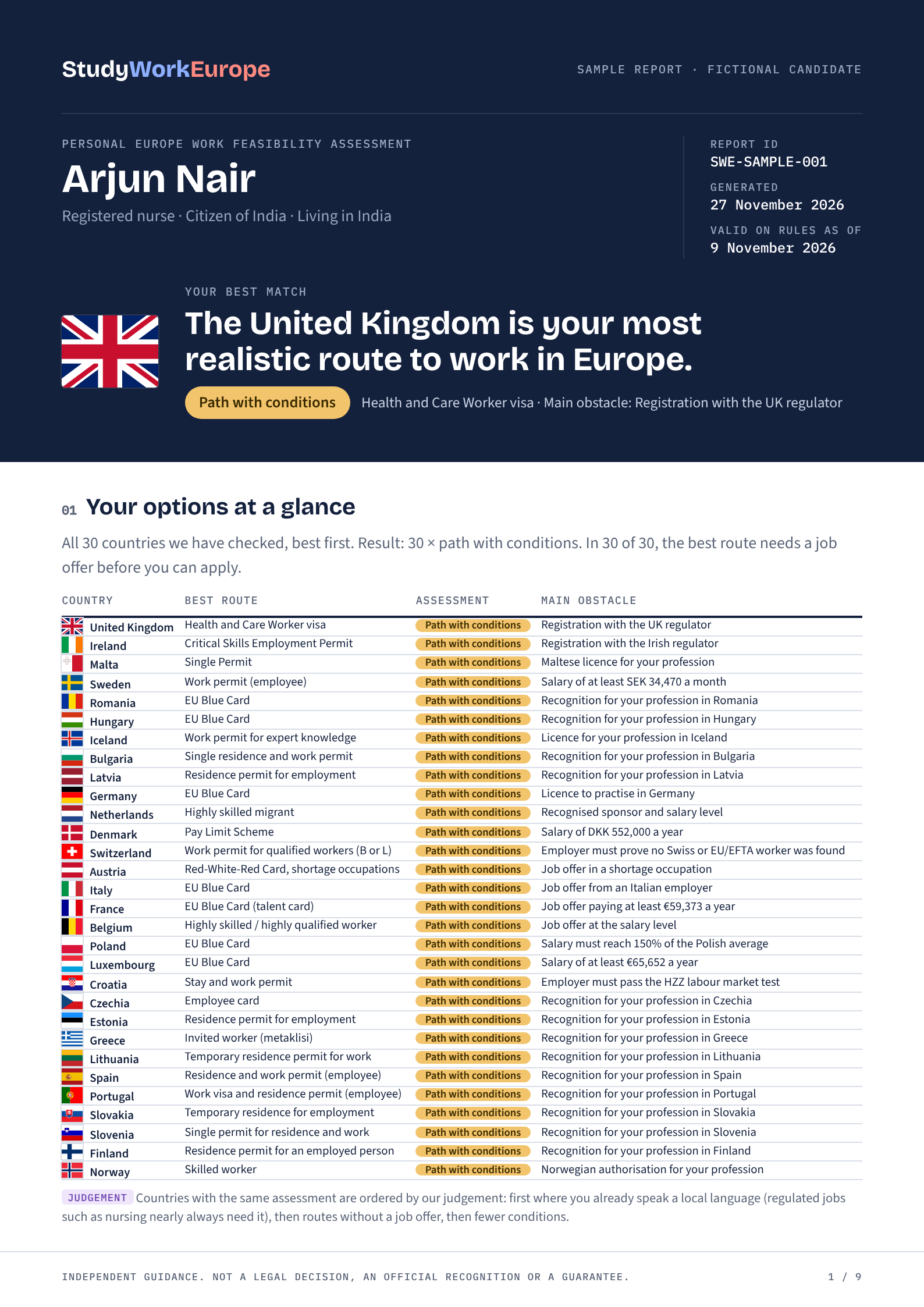
Choose your field and education above. We then check you against the rules of these 30 countries, whose rules we have checked against official sources. More countries follow when their rules are checked.
What people from Serbia need to know
Can Serbians work in Europe? Yes, with a job offer and a permit. Serbian citizens are named in Hungary's National Card, Romania's D/AM1 visa, Czechia's Qualified Employee Programme and Italy's quota list, and Serbian language skills earn points in Austria. Here is what each rule means, with sources.
Short answer: yes, Serbian citizens can work legally in Europe with a job offer. Your passport is on the lists for easier routes in Hungary, Romania and Czechia, and on Italy’s quota list. Slovakia names Serbia for a visa for bus and truck drivers, and Slovenia hires Serbian citizens through its own employment agreement. If you speak Serbian, Austria also gives you language points. Serbia is not on the UK TB test list.
This page is for people with a Serbian passport and no EU passport. If you also have an EU passport, you do not need a work permit in the EU.
Where a Serbian passport helps
| Country | Rule that names Serbia | What it means for you | Guide |
|---|---|---|---|
| Hungary | National Card, only for 8 nearby countries | Any job, also through a staffing agency. The labour office does not test the job market. | Work in Hungary |
| Romania | D/AM1 visa for citizens of Moldova, Ukraine and Serbia | Your employer applies alone, with no placement agency | Work in Romania |
| Czechia | Qualified Employee Programme, 12 countries | A set chance to apply for an employee card at the embassy. No quota figure for Serbia is published. | Work in Czechia |
| Italy | One of 38 countries on the quota list | Reserved non-seasonal places, and access to the seasonal quota | Work in Italy |
| Slovakia | National visa for international bus and truck drivers, 19 countries | A visa for these two jobs, at most 5,000 in 2026 | Work in Slovakia |
| Slovenia | Employment agreement with Serbia | Ordinary jobs only through the agreement: 3-year work permit, any employer after the first year | Work in Slovenia |
The order of this table is our judgement. The quick check above ranks the countries for your own job, education and languages.
Where it does not help
| Route | Who it is for | Serbia? |
|---|---|---|
| Poland: declaration instead of a work permit | Armenia, Belarus, Moldova, Ukraine | No. A Polish employer must get a full work permit for you. |
| Czechia: special work visa for farming and food | Bosnia and Herzegovina, Georgia, Moldova, North Macedonia, Ukraine | No. |
| Hungary: employment permit for guest workers | Georgia, Armenia, the Philippines | No, but the National Card covers the same kind of jobs. |
| UK Youth Mobility Scheme | Listed countries only | No. |
An agent who offers a Serbian citizen a “Polish declaration” or a “Czech special visa” is not telling the truth.
Hungary: National Card
The National Card is only for citizens of Bosnia and Herzegovina, North Macedonia, Belarus, Moldova, Montenegro, Russia, Serbia and Ukraine.
- You need a job offer from an employer in Hungary. The employer may apply for you online.
- It lasts up to 2 years and can be renewed for up to 3 years at a time.
- The labour office does not check if a local worker could do the job.
- OIF says you can apply in Hungary if you have a biometric passport.
- The fee at an embassy is €110.
Romania: visa D/AM1
Since 27 April 2026, Romania’s new law sends most foreign workers through a licensed placement agency, and only for jobs on the shortage occupation list. Serbian citizens working full time can use the D/AM1 route instead. The employer files one online application on WorkinRomania. You then get a long-stay visa (€300) and, in Romania, a single permit for up to 2 years.
Our reading, not IGI’s words: in the law text we read, the shortage list and the yearly quota apply to the other route (D/AM2), not to D/AM1. IGI does not say this directly. Ask IGI or the employer before you rely on it.
Czechia: Qualified Employee Programme
Serbia is one of 12 countries in this programme for mid- and lower-skilled jobs (welders, drivers, assembly workers and similar). It is not a separate permit: you still need an employee card (CZK 5,000 at an embassy, up to 2 years) and your employer must be accepted into the programme. The Czech Ministry of the Interior did not show a quota for Serbia in its report on 2025. Your family cannot apply at the same time as you.
Slovakia: national visa for bus and truck drivers
Serbia is one of 19 countries whose citizens can get Slovakia’s national visa for international bus and truck drivers. It is only for these two jobs.
- At most 5,000 of these visas can be given in 2026.
- The employer must have been a Slovak transport company for at least 10 years.
- The visa lasts up to 1 year and cannot be given again. While you hold it, you may only work for that employer, in that job.
- If you later apply for temporary residence for the same job, the labour office does not first look for a local jobseeker.
You still need a real job offer from the transport company. Work in Slovakia
Slovenia: employment agreement
Slovenia has an employment agreement with Serbia. Citizens of Serbia are hired for ordinary jobs in Slovenia only through this agreement. The single permit that other non-EU citizens use is not the route for you.
- You must be over 18 and registered as unemployed with the public employment service at home (NSZ). That service chooses suitable candidates for the job, or checks the person the employer already has in mind.
- The work contract must last at least 1 year.
- The work permit is valid for 3 years. In the first year you work for the employer that applied. After the first year, you can work for any employer.
- The employer applies for the work permit and pays the €70 fee.
- Serbian citizens sign the work contract at the Serbian employment service (NSZ).
- The agreement does not cover seasonal work or the EU Blue Card. For those, Slovenia’s normal rules apply.
Austria: points for Serbian
Austria’s Red-White-Red Card for skilled workers in shortage occupations needs 55 points. Bosnian, Croatian or Serbian at level B1 gives 5 points, the same as French or Spanish. German still counts most (up to 15 points). This rule is about the language you speak, not your passport. Count your points with our Red-White-Red Card points calculator. Work in Austria
Italy: on the list
Italy’s quota decree for 2026 to 2028 gives 25,000 reserved non-seasonal places a year to citizens of 38 listed countries, and Serbia is one of them. Serbian citizens can also use the seasonal quota. For 2027 the non-seasonal click day is 16 February 2027. Only an Italian employer can apply. Work in Italy
Norway and the UK
- Norway: UDI showed no home-country warning for Serbian citizens on its seasonal worker page when we checked. Work in Norway
- UK TB test: Serbia is not on the UK TB test list. The rule follows where you have lived: if you have lived 6 months or more in a listed country and were there in the last 6 months, you still need a test.
- UK English: Serbia is not exempt. UK work visas need English at level B2.
- UK Youth Mobility: not open to Serbian citizens.
Avoid scams
- The National Card, D/AM1 and the Czech programme all need a real employer who applies or confirms the job. Nobody can sell you a place.
- In Romania, agencies and employers may not charge you for finding the job.
- Check if an employer can sponsor you and read never pay for a job and job scams in Europe.
What this means for you
- Trade or factory job, no degree? Look first at Hungary, Romania and Czechia, where your passport is on the list. In Austria, a trade on the shortage list plus German can be enough.
- Seasonal work? Italy’s seasonal quota is open to you. The Czech special visa is not.
- Degree? The EU Blue Card and Germany are open on the same terms as for other non-EU citizens. Compare salaries with the work permit salary check.
- Learn what B1 and B2 mean in language levels explained.
Sources
- National Directorate-General for Aliens Policing (OIF, Hungary), National Card (Nemzeti Kártya, in Hungarian) Page last edited 3 March 2026. Checked 13 November 2026
- IGI (General Inspectorate for Immigration, Romania), Long-stay visa for employment (in Romanian) Page updated 8 June 2026. Checked 13 November 2026
- IGI, Emergency Ordinance 32/2026 on foreigners' access to the labour market (PDF, in Romanian) Published in the Official Gazette no. 335 of 27 April 2026. Checked 13 November 2026
- Information Portal for Foreigners (Czech Ministry of the Interior), Programmes approved by the Government Updated 7 July 2025. Checked 12 November 2026
- Czech Ministry of the Interior, Report on migration and integration of foreigners 2025 (in Czech) Published 10 July 2026. Checked 12 November 2026
- Information Portal for Foreigners (Czech Ministry of the Interior), Special Work Visa Updated 28 July 2026. Checked 12 November 2026
- Biznes.gov.pl (Polish government service portal), Declaration on entrusting work to a foreigner (in Polish) Updated 1 December 2025. Checked 11 November 2026
- Integrazione Migranti (Italian Ministry of Labour), DPCM of 2 October 2025 on entry flows 2026–2028 (PDF, Articles 6 and 7) Published in the Gazzetta Ufficiale on 15 October 2025. Checked 15 November 2026
- Migration Platform of the Austrian Federal Government, Skilled Workers in Shortage Occupations Checked 9 November 2026
- UDI (Norway), Want to apply – Seasonal workers (citizenship Serbia) Checked 17 November 2026
- GOV.UK, Tuberculosis tests for visa applicants Updated 27 October 2026. Checked 17 November 2026
- GOV.UK, Skilled Worker visa – knowledge of English Updated 14 September 2026. Checked 17 November 2026
- GOV.UK, Youth Mobility Scheme visa – eligibility Updated 16 September 2026. Checked 17 November 2026
- ÚPSVaR (Central Office of Labour, Slovakia): National visas in the interest of Slovakia (in Slovak) Updated 6 May 2026. Checked 17 November 2026
- Employment Service of Slovenia, Work permits: seasonal work up to 90 days and the agreements with Bosnia and Herzegovina and Serbia (in Slovenian) No date shown. Checked 17 November 2026
- Employment Service of Slovenia, Employment of citizens of Serbia (in Slovenian) No date shown. Agreement in Official Gazette 38/2019. Checked 17 November 2026
We sell clarity, not optimism
Many people lose money to fake agents who promise jobs and visas in Europe. We do the opposite. We tell you what is realistic for you, what is not, and where the official rules are written.
We never sell jobs or visas
We do not recruit, take money from employers or pass your details to anyone. You pay once for the report and nothing else.
Official sources, with dates
Every legal statement links to the authority that publishes the rule, with the date we checked it.
Rule, fact or judgement
The report marks what is law, what is a published figure and what is our own assessment. You always know which is which.
A negative answer is still worth having
If no country is realistic for you right now, we say so, and explain what would need to change.
A real company
StudyWorkEurope is run by Gravityrock AS, a registered Norwegian company, org. no. 937 920 482. The same team runs JobsNorway.
StudyWorkEurope is
- An independent assessment of your options
- A clear plan with official links
- Honest about what we do not know
StudyWorkEurope is not
- A recruitment agency or job board
- A visa service or law firm
- A guarantee of a job or a permit